
On October 29, 2026, the richest man in history posted on X:
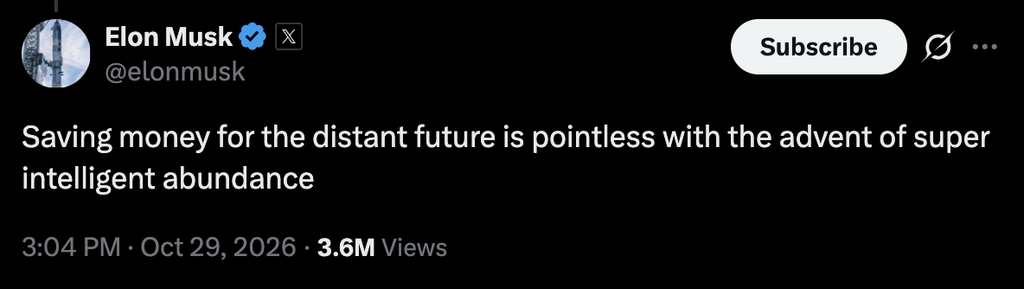
I read that line three times. Then I opened my banking app, looked at my savings, and asked myself a question I think many of you are asking right now. Is he right? Should I stop saving? Should I spend everything today because tomorrow, robots will give me whatever I want for free?
I have been going down the rabbit hole of money for years now. I have read about Rai stones, glass beads, gold, the Roman Empire, the Federal Reserve and Bitcoin. And the more I read Musk’s prediction, the more I realized something. He is right about abundance. But the narrative is missing the most important half of the story.
The future is not only an age of abundance. It is an age of abundance and scarcity. If you understand which is which, you will know what to do with your money, your time and your life for the next twenty years.
Let’s go through it.
The Promise of Abundance
This was not a random tweet. Musk has been building this idea for years.
In December 2025, Ray Dalio praised the new “Trump Accounts” that give newborns a $1,000 investment account. Musk called it a nice gesture, but then added: “There will be no poverty in the future and so no need to save money.” He followed it with one more line: “There will be universal high income.”
Not basic income. High income.
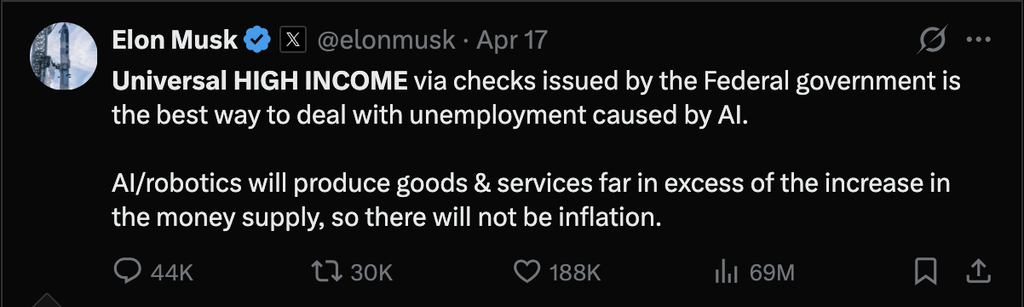
In April 2026, he went further. He wrote that “Universal HIGH INCOME via checks issued by the Federal government” is the best way to deal with unemployment caused by AI. His argument was that AI and robots will produce goods and services much faster than the money supply grows, so there will be no inflation. In an interview with The Economist, he put a date on it: “Money won’t matter in 2036.” He even described what work will feel like: “Work will be like tending a garden.” You won’t need to do it, but maybe you will want to.
Then, at the 2026 Abundance Summit with Peter Diamandis, he said something that made me stop and think much harder:
“AI won’t use human currency. It will care about power and mass: wattage and tonnage.”
Keep that line in mind. We will come back to it. I believe it is the most important thing Musk has said about money, and it actually argues against his own conclusion.
To be fair, the vision is beautiful. Factories run by robots. Humanoid robots doing the dishes and building houses. AI doctors, AI lawyers and AI teachers available to every child on earth for almost nothing. Superintelligent systems solving problems we have not even named yet. When I reviewed Nick Bostrom’s Superintelligence, I wrote that these machines will probably replace the entire human workforce. I still believe that is where we are heading.
So let’s accept the premise. Let’s say Musk is right and AI makes almost everything abundant.
The question is: what becomes scarce?
Because something always does.
I Have Heard This Story Before
In 1930, the economist John Maynard Keynes wrote an essay called Economic Possibilities for our Grandchildren. He predicted that within a hundred years, productivity would grow so much that people would work only around fifteen hours a week. The “economic problem,” as he called it, would be solved. Humanity’s real challenge would be what to do with all the free time.
We are now only a few years away from his hundred-year deadline. Productivity did explode. So, are you working fifteen hours a week? Do you know anyone who is?
Keynes was right about abundance. He was wrong about humans. We did not take the abundance and relax. We took the abundance and competed for new things.
We also had a small rehearsal of “free money” very recently. During the lockdowns, governments around the world printed uncountable amounts of money and sent checks to their citizens. People stayed home and bought things they did not need. Why wouldn’t they? It was free money. Nobody worked for it. And what happened next? Prices went up everywhere. In 2022, more than 50 countries had double-digit inflation. Life savings melted. No aliens came to pay the bill. Future generations are paying it, long before they are even born.
Musk would say this time is different because AI really does produce the goods. Fair enough. The lockdown checks were money without production. AI promises production without workers. That is a real difference, and I take it seriously.
But remember the glass beads of Africa. For centuries, glass beads were used as money in parts of the continent because they were hard to make. Then Europeans arrived with the technology to produce them cheaply and in unlimited amounts. The beads did not make Africans rich. They made the beads worthless, and the wealth flowed to whoever controlled the factory.
Abundance does not automatically make you rich. It makes the abundant thing cheap. Those are not the same thing. So the real question is not “will there be abundance?” The real question is “who owns the abundance, and what will still be scarce after it arrives?”
Even Musk admits the transition will be “bumpy.” The reports on his predictions also raise open questions about who will own the machines and how the benefits will be shared. Remember the Cantillon effect. Those closest to the source of new money benefit the most, and those furthest away pay for it. If universal high income comes as checks from a central authority, the people closest to the printer will still be first in line.
What Do Humans Actually Want?
Here is where I think the whole debate goes wrong. We keep talking about money as if people want money.
They don’t.
Nobody actually wants a piece of paper with a face on it, or digits in a database. When I wrote my first post about money, I listed why people chase it. Some do it to make a living, some for power, some to buy stuff, some to help others, some for status, some to impress others. Most people sacrifice their finite time for money, and some even put it before their relationships.
Look at that list again. Not a single item on it is money itself. Money is just the bridge between where a person is and what they want to become. It is a tool. And very few people use it as a tool of freedom.
Psychologists have studied this for decades.
Abraham Maslow described a hierarchy of needs back in 1943. At the bottom are food, water, shelter and safety. Above that come belonging and love. Above that come esteem and recognition. At the very top is self-actualization: becoming who you are capable of becoming. AI abundance can solve the bottom of that pyramid, and I truly believe it will. But the higher you climb, the less AI can hand to you, because those needs are about other humans and about yourself.
Self-Determination Theory, developed by Edward Deci and Richard Ryan, says humans have three core psychological needs:
- Autonomy: control over your own life
- Competence: being good at something that matters
- Relatedness: meaningful connection with others
Notice something? A government check gives you none of them. A check can even take autonomy away, because the one who gives can also stop giving.
Then there is the famous happiness research. In 2010, Daniel Kahneman and Angus Deaton found that day-to-day emotional well-being seemed to stop rising at around $75,000 a year. Later, Matthew Killingsworth found that happiness keeps rising with income for most people. In 2023, the two sides worked together and found that the plateau appears mainly among the least happy group. Either way, the lesson is the same. Money helps, especially when it removes suffering. But after a point, more stuff does not buy more meaning.
The economist Richard Easterlin showed something even more interesting in the 1970s. Inside a country, richer people are happier than poorer people. But when the whole country gets richer over time, average happiness barely moves. Why? Because humans don’t measure themselves in absolute terms. We measure ourselves against each other.
This is the key that unlocks the whole age of abundance.
The philosopher René Girard called it mimetic desire. We don’t know what we want, so we want what others want. In 1976, the economist Fred Hirsch gave a name to the things we compete for: positional goods. Their value comes from the fact that not everyone can have them. The house with the ocean view. The front row at the concert. A seat at the top university. Being first. Being recognized. Being the best in the room.
AI can make a million copies of a painting. It cannot make a million originals. It can build a million houses. It cannot make a million houses with the best view of Mount Fuji. It can give everyone a car. It cannot give everyone the top spot. The moment everyone has something, it stops being a signal of anything.
So in a world where AI makes everything cheap, human desire does not disappear. It simply moves to whatever is still scarce.
Universe 25
Let me tell you about a strange and dark experiment.
In 1968, an American researcher named John B. Calhoun built a “mouse utopia” called Universe 25. It had unlimited food and water, no predators, no disease and a perfect temperature. It was designed for thousands of mice. In other words, it was total abundance.
At first, the population boomed. Then it peaked at around 2,200 mice, far below capacity, and the society started to break down. Mothers abandoned their young. Males stopped defending territory. A group Calhoun called “the beautiful ones” did nothing but eat, sleep and groom themselves. They never fought, never mated and never took any risk. Eventually births stopped, and the colony died out completely, surrounded by food.
Humans are not mice, and we should be careful with this comparison. Scientists still argue about what the experiment really proves. But the core lesson stays with me. Removing the scarcity of resources did not create a paradise. It removed purpose. And when purpose disappears, abundance becomes a cage.
Musk says work will be like tending a garden. I hope he is right. But a garden only feels meaningful because the plants can die. Take away all risk and all effort, and you take away the very thing that makes the harvest feel like your harvest.
The Things AI Cannot Print
So what will be scarce in the age of AI? Let’s think from first principles.
1. Time
Ludwig von Mises wrote that man is subject to the passing of time. He comes into existence, grows, becomes old and passes away. That is why our time here is so scarce. When I read Principles of Economics by Saifedean Ammous, this idea changed the way I see everything. Material resources on Earth are not really scarce. If Earth were the size of a soccer field, all the mines in the world would be roughly the size of a small desk. What is scarce is the time it takes to turn resources into goods.
AI will cut the time needed to produce goods to almost zero. Fantastic. But it will not make your time any longer. You will still have one life, one body and twenty-four hours a day. Every hour you spend on one thing is an hour you cannot spend on anything else. Abundance makes stuff cheap. It makes human time relatively more expensive.
2. Energy
Remember Musk’s line: wattage and tonnage. When the richest man in the world says AI will care about power, not human currency, he is telling you that the real money of the future is energy. Every AI model, every robot and every data center runs on electricity. You can print dollars. You cannot print a gigawatt.
3. Land and location
There is only one Shibuya crossing, one Manhattan, one Kathmandu valley. AI cannot create more of the Earth’s surface in the places people want to live.
4. Trust and truth
When AI can generate any image, voice, video or document in seconds, what becomes rare? The truth. Proof that something really happened. Proof that a human really did it. We are entering a world where content is infinite and trust is scarce.
5. Human connection
You can have an AI friend that never gets tired of you. But you will still want your mother’s cooking, a friend who chose to show up when they had other options, a crowd singing together in a stadium. Those moments are valuable because a human gave something scarce: their time and attention.
6. Status
As we discussed, status is positional. By definition it cannot be abundant. If everyone has it, nobody has it.
7. Truly hard money
Finally, money that nobody can print, not even an AI. More on that below.
Look at that list. Almost every item shares one property: it cannot be faked cheaply. Creating it takes real cost.
There is a word for that.
Proof-of-Work in a World of Free Stuff
About five thousand years ago, the Egyptian civilization built the Great Pyramid of Giza. It took decades of work by tens of thousands of people. That is why we still stand in front of it with our mouths open. It is beautiful, but that is not the main reason. We stand there because we can see the cost. It is the evidence of proof-of-work carried out by a civilization. It could not be built cheaply, and that is exactly why it means something.
In the age of AI, the cost of producing almost everything falls toward zero. So what will humans value? The things that still cost something real. A handmade object. A hard-earned skill. A promise kept for twenty years. A body trained for a marathon. A signal that cannot be copied by pressing a button.
This is also why I believe Bitcoin becomes more relevant in an age of abundance, not less.
Think about it. Bitcoin is the first money in human history whose rules of issuance are set in stone for more than a hundred years. The supply is fixed at 21 million. After the April 2024 halving, the block subsidy became 3.125 BTC, and it will keep halving every four years. No emperor, central bank, corporation or superintelligence can print more. The only way to create new bitcoin is to spend real energy. Wattage.
Now put Musk’s two predictions side by side:
- AI will produce so much that money won’t matter.
- AI will care about power and mass: wattage and tonnage.
If the most intelligent system in history cares about energy, then money tied directly to energy becomes the natural money for machines and humans alike. That money cannot be printed or inflated, and it cannot be stopped at a border. In my post on Money, I imagined the years 2106 to 2140, when miners all over the world will spend tremendous energy to mine the last satoshis. I called it the longest-fought, non-physical, peaceful war in the history of our civilization. In an age of AI abundance, that war over the scarcest unit becomes even more meaningful.
The Twist: Musk’s Own Argument Says Save
Here is the part I think most people miss.
Musk says the main economic challenge of the AI age will be deflation, not inflation. Goods and services will grow faster than the money supply, so prices will fall.
Let’s think about what deflation means. If prices fall every year, then every unit of money you save today buys more tomorrow. In a truly deflationary world, saving is not pointless. Saving becomes the most rewarded behavior in the entire economy. That is exactly the argument Jeff Booth makes in The Price of Tomorrow: deflation is the key to an abundant future.
So why would Musk say saving is pointless? Because in a fiat world, governments will not allow deflation. They will print money to fight falling prices, as they always have. The universal high income checks he proposes are exactly that: new money flowing from a central authority. Technology makes things cheaper. Central banks print money that makes them expensive again. And the people holding fiat savings pay the difference.
So the honest conclusion is not “don’t save.” The honest conclusion is: “Don’t save in something that can be printed.”
That is a completely different message.
Why I Will Keep Saving
I have written about time preference before. People with high time preference choose pleasure now over a bigger reward later. People with low time preference delay gratification. They save, invest and build. The Stanford marshmallow experiment followed children who could wait for a second marshmallow, and they tended to do better years later. Societies with low time preference build cathedrals, universities and pyramids. Societies with high time preference eat their seed corn.
When the richest man in the world tells millions of young people not to worry about saving, he is pushing the whole world toward high time preference, whether he means to or not. History has never rewarded that.
In computer science, when we design an algorithm, we calculate its Big-O complexity for the worst case, not the best case. We don’t write code assuming everything will go perfectly. I see personal finance the same way. Musk’s future is the best case. Maybe it comes in 2036. Maybe it comes in 2056. Maybe it comes in a form where a few people own the robots and everyone else depends on a check that a few men behind closed doors can change.
And think about what that check might look like. In my post on CBDCs, I warned that programmable money can come with an expiry date, conditions and controls. A universal high income paid in programmable central bank money is not freedom. It is a leash with a comfortable collar. Whoever controls your income controls your choices. Not your keys, not your coin. Not your income, not your life.
We are also living through what Strauss and Howe called the Fourth Turning: a period of crisis when old orders collapse and new ones are born. Crises don’t respect predictions. The people who come out of a crisis with their freedom are the ones who prepared for the worst case while hoping for the best.
So yes, I will keep saving. Not out of fear of the future, but out of respect for it. I will save in what is scarce. I will invest my time in skills and relationships that cannot be automated. And I will treat abundance as a gift to use wisely, not as an excuse to stop thinking.
Abundance of Things, Scarcity of Meaning
Musk may be right that AI will produce more than we can consume. I hope he is. I hope my grandchildren grow up in a world where nobody goes hungry, nobody dies of a curable disease and nobody has to sell their whole life to pay rent.
But even in that world, humans will still want what humans have always wanted. Not money, but what money does. Freedom to choose. Respect from people we respect. Time with people we love. A purpose bigger than ourselves. And proof that our lives, like the pyramid, cost something real.
The age of abundance will not end scarcity. It will move it away from food and goods, toward time, energy, trust, meaning and truly hard money.
In the age of abundance, the most valuable thing will be whatever is still scarce.
The question is not whether money will matter. The question is whether you will be holding the right kind of scarcity when the abundance arrives.
Only time will tell. And time, as always, is the scarcest thing of all.
If you want to go deeper, I highly recommend Principles of Economics and The Bitcoin Standard by Saifedean Ammous, Superintelligence by Nick Bostrom, The Price of Tomorrow by Jeff Booth and The Fourth Turning by William Strauss and Neil Howe.
Thank you for reading. Hope you enjoyed it. See you on next one.